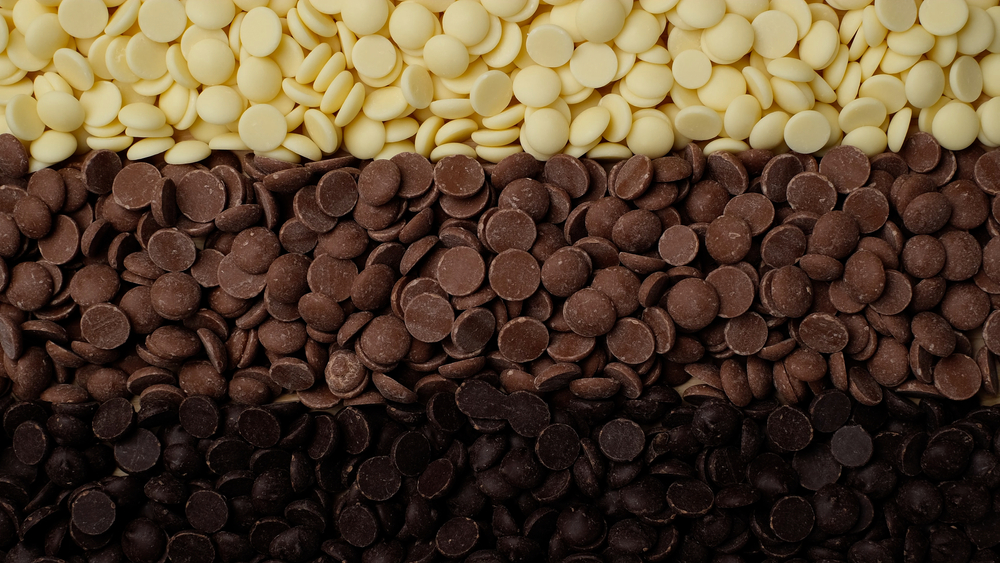
Chocolate drops are first and foremost a form of chocolate
Two types of chocolate drops may look very similar, yet behave quite differently during processing. Their shape alone does not determine the product's composition or technical properties. European legislation defines chocolate primarily by its composition and minimum cocoa solids content, not by whether it is supplied as a bar, block or drop.
Cocoa percentage is not the only factor
Cocoa solids content has a significant influence on the character and flavour of chocolate. However, when selecting chocolate for professional applications, the percentage stated on the product is not the only factor to consider. The formulation and fluidity of the chocolate during processing are also important.
Fluidity affects, for example, the thickness of the coating, how the chocolate behaves in moulds and the enrobing process. More fluid chocolate is suitable for thin shells and delicate coatings, while less fluid chocolate may be better suited to applications where a thicker layer is required. The amount of cocoa butter in the formulation is one of the factors that influence fluidity.
A higher cocoa percentage therefore does not automatically mean that a particular chocolate is better suited to a specific product. Its flavour profile must be assessed alongside its technical properties and intended application.
When does chocolate need to be tempered?
This depends primarily on the role the chocolate plays in the finished product. When it is incorporated into ganache, a cream, chocolate mousse or another mixture, tempering is generally not required. However, the chocolate must still be processed in accordance with the method specified in the recipe.
What exactly is tempering?
Tempering is a controlled process of managing chocolate temperature to promote the formation of a stable cocoa butter crystal structure. Properly tempered chocolate has a smooth, glossy surface and a firm, clean snap. When used in moulds, it also releases more easily once cooled and set.

Chocolate drops for baking? It depends on the desired result
Chocolate drops can also be added directly to doughs and batters, for example when making cookies, muffins and other baked goods. However, it is important to consider how the chocolate is expected to behave during baking.
There are also chocolate products specifically developed for baking, with formulations designed to help them retain their shape at higher temperatures. The behaviour of our chocolate drops in doughs and batters may vary depending on the variant selected and the baking temperature profile. The drops may melt more extensively or remain visible as pieces of chocolate inside the baked product.
For a bakery, the ideal chocolate may therefore differ from the one used to make pralines or ganache. The chocolate should be selected according to the desired result of the specific recipe.
Chocolate drops and compound coatings are not the same
The key difference lies in their composition and the type of fat used. Cocoa butter is the characteristic fat in real chocolate. Under certain conditions, European legislation also permits the addition of specific vegetable fats, up to a limit of 5%. However, we do not use these added vegetable fats in any of our chocolate products.
In our compound coatings, by contrast, we use specially selected vegetable fats that give the products different processing properties. We also offer compound coatings in drop form, so a similar shape does not necessarily mean the same composition or application. These coatings are designed for easier melting, application and setting, and do not require tempering in the way real chocolate does.
This does not mean that one product is inherently better than the other. Chocolate and compound coatings simply meet different production requirements.
How to store chocolate drops
Chocolate drops should be protected from heat, moisture, direct light and strong odours. Stable, dry storage conditions and tightly sealed packaging are essential to preserving the chocolate's properties and ensuring reliable processing later on.
For more information on the correct storage of chocolate drops, compound coatings, fillings, fondant and other semi-finished products, read our article: How to Store Chocolate and Confectionery Ingredients Correctly in Production.
Which chocolate drops do we offer?
We manufacture real chocolate drops for professional bakery, pastry and food production. Our current range includes dark chocolate drops with cocoa solids contents of 48%, 51%, 60% and 70%, as well as 51% mini chocolate drops and milk chocolate drops with cocoa solids contents of 32% and 37%. In our current B2B range, white chocolate is available in strip form.

For industrial customers, we supply chocolate drops in 15 kg bags. Selected varieties are also available in 5 kg cartons within our foodservice range. For large-scale production, we also offer bulk deliveries of liquid chocolate by tanker.
Our sales representatives can also advise on the selection of a suitable variety and arrange samples. This allows the choice of chocolate to be tailored to the type of operation, the specific product and the processing technology used.
How do you choose the right chocolate drops?
Start with the product you want to make. You may need one type of chocolate for ganache, another for pralines and another for baked goods in which visible pieces of chocolate should remain after baking. In addition to flavour and cocoa solids content, it is therefore important to consider the chocolate's fluidity, processing method and the desired result.
The main advantage of chocolate drops is their practical format. They are easy to portion, require no cutting before processing and are convenient to melt. However, their shape alone does not indicate which chocolate will be best for a particular production process. That depends primarily on the properties of the specific chocolate and how it will be used.
In professional production, it therefore makes more sense to choose chocolate according to the function it needs to perform in the finished product, rather than relying solely on the cocoa percentage stated in its name.